
3 Reasons Tire Prices Are Still Struggling to Rise in 2026
Rising costs are usually expected to support higher selling prices. However, in the tire industry, that logic is becoming less reliable. In 2026, tire prices remain difficult to raise even as raw material, energy, and freight costs continue to move higher.
For many tire manufacturers, this is becoming one of the most important challenges in the market. The issue is not simply cost inflation. The bigger issue is that pricing power remains weak while supply pressure is still increasing.
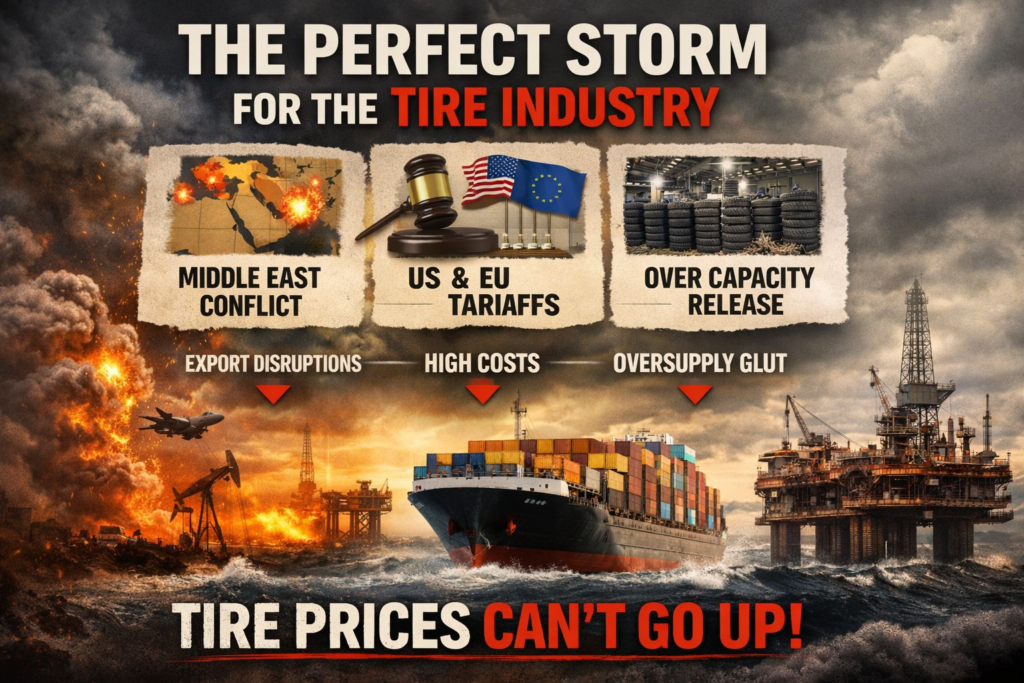
Several factors are driving this situation at the same time. Middle East tensions are adding uncertainty to oil prices and freight costs. Trade barriers in the United States and Europe continue to weigh on exports. At the same time, additional tire production capacity is entering the market, creating even more supply pressure across the industry.
As a result, many manufacturers are facing a difficult reality: costs can go up, but tire prices do not automatically follow.
1. Rising Costs Are Not Translating Into Higher Tire Prices
In many manufacturing sectors, higher input costs often lead to higher selling prices. But the tire industry is different. Even when producers face higher costs for rubber, chemicals, labor, energy, and logistics, they are not always able to pass those costs on to customers.
One key reason is intense competition. Buyers have more sourcing options than before, and suppliers are still competing aggressively for orders. In this kind of market, tire prices remain under pressure because customers can compare offers more easily and shift to alternative suppliers when pricing becomes less competitive.
This means that higher operating costs are often absorbed by manufacturers instead of being reflected in higher tire prices. For many producers, the result is not stronger pricing, but tighter margins.
2. Trade Barriers Are Weakening Pricing Power
Trade barriers are another major reason tire prices are still difficult to lift. Anti-dumping measures, tariff uncertainty, and other trade defense actions in Western markets are making exports more challenging, especially for manufacturers that rely heavily on a single production base.
For export-oriented factories, this creates a double pressure. On one side, production and logistics costs continue to rise. On the other side, market access becomes more complicated and pricing becomes more sensitive. This makes it harder to increase tire prices without risking lost orders.
Shipping uncertainty adds even more pressure. When freight costs are unstable and delivery schedules are harder to predict, buyers tend to become more cautious. That further limits the ability of suppliers to push through price increases.
3. Expanding Capacity Is Keeping Tire Prices Under Pressure
The continued release of new production capacity is also making it harder to raise tire prices. When supply grows faster than demand, price competition usually becomes more intense. That is exactly what many tire manufacturers are dealing with today.
Even if raw material costs and freight rates move higher, oversupply can prevent the market from accepting higher prices. In this environment, tire prices remain weak not because costs are stable, but because competition is still increasing.
This is why capacity expansion remains one of the most important issues for the tire industry in 2026. More volume in the market does not automatically create better profitability. In many cases, it creates more pricing pressure.
Why Tire Prices May Remain Difficult to Raise in 2026
The biggest challenge for the tire industry in 2026 may not be inflation itself. It may be the fact that tire prices are still hard to lift in a market shaped by rising costs, trade risks, and growing supply.
That also means the real competitive advantage is changing. It is no longer only about production scale. It is increasingly about:
- global manufacturing footprint
- supply chain resilience
- diversified customer structure
- disciplined margin management
Companies with stronger global operations and more balanced customer portfolios are likely to be better positioned to handle weak tire prices and ongoing market uncertainty.
You may also be interested in our guide on how to choose a reliable tire supplier and our article on how to import tires from China.
Conclusion
Tire prices are still struggling to rise because the industry is being squeezed from several directions at once. Rising raw material costs, freight uncertainty, trade barriers, anti-dumping pressure, and continued capacity expansion are all affecting pricing power.
When these factors come together, the result is usually not successful price increases. Instead, it is stronger competition and greater pressure on profitability. For tire manufacturers, the key question in 2026 is no longer who can produce more. It is who can remain profitable when tire prices refuse to move up.
If you would like to learn more about the tire industry or how to import tires from China, please contact us through the channels below:
- WhatsApp / WeChat: +86 132 0636 9528
- Companies facing weak tire prices also need stronger supplier strategies. Read our guide on how to choose a reliable tire supplier
#TireIndustry #TireManufacturing #SupplyChain #GlobalTrade #AntiDumping #Manufacturing #Logistics #OilPrice #ExportBusiness #IndustrialStrategy